
HELM is a tool for comparing the performance of traditional and innovative onboard energy systems, considering power units, onboard fuel storage, and main auxiliary systems. The tool database has been developed throughout a wide analysis of the available market solutions in terms of energy generation devices (i.e. fuel cells, internal combustion engines) fuels (MGO, hydrogen, natural gas, methanol, ammonia) and related storage technologies (batteries, SCR, fuel treatment systems). Many of these data have been collected also thanks to the laboratory experience of the authors’ research group on different innovative energy systems.
Based on the database, a wide range of maps has been generated, correlating costs, volumes, weights, and emissions with both installed and operational power, as well as with the required range specified by the user as input. The tool highlights the most promising solution according to the different relevance assigned to each key parameter (i.e. costs, volumes, weights). It is worth noting that the methodology has a general value, as the tool can be applied to both the design of new ships, and to the retrofit of already existing ships in order to respect new requirements (e.g. more and more stringent normative in terms of pollutant emissions in ports and restricted areas). Furthermore, the database can be easily extended to other generation and storage technologies.
Concept and approach
Many parameters can affect the choice of the best technology in terms of economic and technical aspects but also safety, comfort and expected navigation areas are relevant. In order to take into proper account these many parameters, the Thermochemical Power Group (TPG) at University of Genoa has developed a tool that calculates all the main properties for each technology suggesting the most suitable for the desired application: HELM (Helper for Energy Layouts in Maritime applications).
At the core of the tool is a comprehensive database, built through in-depth market analysis and private communications with multiple companies, encompassing storage systems, power units, and primary auxiliary systems. From this database, specific maps have been created correlating the main parameters (such as weights, volumes and costs) with the size required by the system.

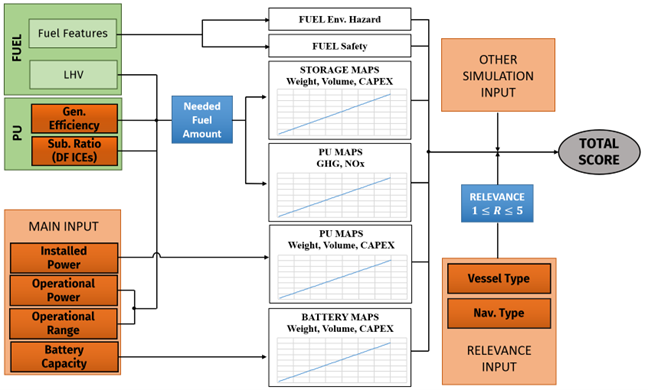
The main inputs include both the installed and operational power required by the vessel, together with the operating hours between dockings. In this context, also the battery capacity must be defined, if required by the energy system configuration. Multiplying the operational features, the energy required by the ship is obtained. Dividing this energy by the system efficiency, the amount of fuel needed is calculated and then used as input in the dedicated storage map reporting its parameters (weight, volume, cost). For what concerns the power unit, the size is given by the installed power, therefore this value can be directly inserted in the dedicated power unit map to obtain the power unit parameters.
Furthermore, the emissions are evaluated using maps for each configuration, where the input is the amount of fuel consumed, depending both on fuel type and power unit. GHG emissions are then used to estimate the penalties under the EU ETS and Fuel EU frameworks, where applicable.
HELM gives an evaluation of the most suitable technology for the scenario considered; this evaluation is represented by the score of each technology: the best application obtains the highest total score. The total score for each solution is calculated as the sum of the individual scores obtained across two main categories: techno-economic and statistical. Volume, weight, and cost scores belong to the techno-economic category and they are rated on a scale from 1 to 10. Environmental hazard and fuel safety scores fall under the statistical category. For these metrics, a reduction factor is applied to properly account for the likelihood of accidental leakage, distinguishing between potential damage to the environment and to human health, respectively.
Since each application has specific requirements the resulting score is affected by the relevance parameters, automatically assigned by means of the relevance inputs selection, and depending on the considered application. The only exception is the cost relevance, which must be defined by the user. The score for each technology is then multiplied by the corresponding relevance (i.e. if weight relevance is 3, the maximum score for the weight category is 30 points). Taking into account the ship’s dimensions and the available power unit sizes, the tool highlights the technologies that are not feasible for the chosen application.
Fields of application
HELM can be used in a preliminary design phase, both in case of new applications or renovation of existing ships. Every vessel is strictly characterized by the scenario of application. Therefore it is necessary to choose accurately the initial inputs in order to properly analyse the scenario. All the types of ships can be studied with this tool, from small to large size. Therefore yachts, ferries and cruises of different size can be analysed, as well as bulk carriers, containerships, tankers, etc. Furthermore it is possible to analyse and simulate the cases where only energy for services (such as hotel services) or the overall power, propulsion included, are taken into account.

Publications
A multi-criteria approach for comparing alternative fuels and energy systems onboard ships
M. Rivarolo, S. Piccardo, G.N. Montagna, D. Bellotti
Energy Conversion and Management: X, 2023, Vol. 20, 100460. https://doi.org/10.1016/j.ecmx.2023.100460
Multi-criteria comparison of power generation and fuel storage solutions for maritime application
M. Rivarolo, D. Rattazzi, L. Magistri, A.F. Massardo
Energy Conversion and Management, 2021, Vol. 244, 114506. https://doi.org/10.1016/j.enconman.2021.114506
Clean energy production by PEM Fuel Cells on tourist ships: A time-dependent analysis
M. Rivarolo, D. Rattazzi, T. Lamberti, L. Magistri
International Journal of Hydrogen Energy, 2020, Vol. 45, Issue 47, 25747-25757. https://doi.org/10.1016/j.ijhydene.2019.12.086