
In the framework of FLEXnCONFU (FLEXibilize combined cycle power plant through power-to-x solutions using Non-CONventional FUels) European project, a Power-To-Ammonia-To-Power test rig has been developed.

Power To Ammonia
The cycle begins with hydrogen production through an electrolyzer, which operates at a maximum capacity of 15 kWel to generate up to 3 Nm3/h of H2 at 8 barg from water as the feedstock.
For initial feasibility tests, nitrogen is supplied from nitrogen bottles with a purity of 99.9998 vol%. To be compliant with the electrolyser working pressure, the high-pressure nitrogen is reduced to 8 barg.
The recycle stream, consisting of unreacted hydrogen, nitrogen, and any remaining ammonia, is mixed with the fresh hydrogen and nitrogen streams.
Then, this mixture is fed into a compressor, to raise the pressure of 80 barg required by the catalytic reactor. During compression, the gas heats up, and a subsequent electrical heater further elevates the temperature to meet also the temperature target imposed by the reactor.
The reactor features a fixed bed, tube-in-tube design. The inner high-pressure tube contains a second-generation iron-based catalyst, while the outer tube includes two electrical heating coils wrapped around the inner tube and allows air to flow through the space between the tubes. This design facilitates both heating during start-up and cooling during steady-state operation. The electrical heaters placed on the reactor enable rapid start-up by providing the activation energy necessary for the reaction. Once the reaction becomes self-sustaining, the heaters are switched off and are only reactivated during start-ups or significant temperature adjustments.
At the reactor outlet, the products are initially cooled to 60°C using an air heat exchanger. The mixture is then cooled to 15°C through a water heat exchanger. At this lower temperature, a large portion of the produced ammonia condenses, which is subsequently collected and stored in a pressure vessel.
A fraction of the gaseous phase exiting the condenser may be removed via a purge valve. The purge serves two purposes: regulating the pressure in the high-pressure section and removing unwanted impurities, such as argon from nitrogen bottles or less pure nitrogen supplied by the PSA unit.
The remaining gaseous mixture is then recycled through an expansion valve to adjust its pressure to match that of the incoming hydrogen and nitrogen streams.
A scrubbing system with a 1 m3 water-filled tank is included as a safety measure. This system serves to prevent the release of ammonia into the atmosphere during the purging process and acts as a safeguard in case of a malfunction in the pure ammonia storage system.


Ammonia To Power
A dedicated test rig has been developed to enable the Turbec T100 mGT to operate with various ammonia-based fuel mixtures.
Four independent fuel lines, dedicated to H2, N2, natural gas, and NH3, were installed, allowing the preparation of mixtures ranging from NG–ammonia blends to combinations of hydrogen, nitrogen, and ammonia for simulating different levels of ammonia cracking. To accommodate these capabilities, the original T100 fuel system was disconnected and replaced with custom components.
All piping and fittings are made of AISI 316 stainless steel, with Teflon or EPDM seals suitable for ammonia operation. Moreover, instead of the onboard gas compressor, an external supply system provides natural gas at roughly 7 bar, while a gas mixer enables blending of ammonia and other gases. Hydrogen and nitrogen are delivered from 200-bar cylinders and regulated through pressure-reducing stages. Ammonia is stored in three 20-kg cylinders.
All fuel lines are equipped with Mass Flow Controllers, and a 12-m, 1-inch coil downstream of the mixer is included to decouple controller dynamics from the operation of the T100 pilot and main valves. A safety valve routes any over-pressure discharge to a water scrubber, exploiting ammonia’s high solubility. Finally, the original brass injection valves of the microturbine were replaced with stainless steel components to ensure compatibility with ammonia.
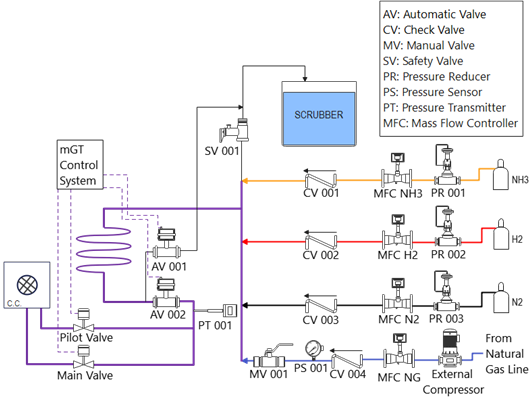

Moreover, operating the T100 with fuel blends having a lower lower heating value than natural gas requires a higher fuel-to-air ratio to ensure stable combustion. For this reason, the microturbine’s combustion chamber was replaced with a new design featuring enlarged dilution holes and increased fuel nozzle orifice sizes compared to the natural-gas version, thereby improving its suitability for low-LHV fuels.


Several experimental campaigns have been conducted successfully, achieving stable operation with NH₃/NG mixtures containing up to 50 %vol NH₃, as well as with NG/fully cracked ammonia mixtures containing up to 60 %vol cracked ammonia.
Details on the mGT T100
The micro gas turbine test rig is based on a Turbec T100 PHS Series 3 operating in stand-alone configuration or connected to the electrical grid with a suitable safety interconnection panel. It consists of a complete module for power production (100 kW at nominal conditions), a heat exchanger located downstream of the recuperator outlet (hot side) for co-generative applications, and two battery packages for the start-up phase when the machine operates in stand-alone configuration. Even if the machine is located indoors, the outdoor roof was mounted over the power module to use its air pre-filters.
The power module includes a single shaft radial machine (compressor and turbine) operating at a nominal rotational speed of 70000 rpm (beta=4.45) and a TIT of 950°C, that is 1223.15 K, a natural gas fed combustor, a primary-surface recuperator directly attached to the turbine outlet, a water cooled high speed generator, a power electronic unit (rectifier, converter, filters and main circuit breaker), an automatic control system interfaced with the machine control panel, and the auxiliaries. The machine control system operates at constant rotational speed in stand-alone mode, whereas, in the grid-connected mode, it performs a constant TOT control strategy.
The heat exchanger for water heating, available for co-generative applications, includes an exhaust gas by-pass for water temperature control. Each start-up battery package includes thirty 12 Volt batteries connected in series for a nominal voltage of 360 Volt DC.

Ammonia Cracking Test – Rig
In order to evaluate ammonia cracking process depending on the chosen catalyst, a dedicated test rig based on a batch reactor has been developed.
The test rig is divided into two zone (“hot zone” and “cold zone”) according to the different operating temperatures. The “hot zone” is characterized by the reactor operating temperature (i.e. from 450°C to 650°C) whereas the “cold zone” remains at the ambient one. Temperature and pressure sensors have been installed in each zone to be able to achieve a complete characterization of the plant. The acquisition system has been developed in LabVIEW environments and the acquisition time has been set equal to 1s.

Here below the main data referring the system’s component are reported:
- The batch reactor is made of stainless steel AISI 316 and the ammonia is injected into the reaction zone via 6 mm pipe (external diameter). The reaction zone has an overall volume of 90 cm3.
- Two type J thermocouples with an operating range from -40 °C to 750 °C are present into the reaction zone to continuously measure the real reactor temperature.
- One pressure sensor ranges from –1 to 17 barg with an accuracy of ±0.5% is installed in the “hot zone” as well as a second one is installed in the “cold zone”. Pressure measurement in the “hot zone” is required to be able to correlate the increase in pressure with the amount of ammonia that is decomposed inside the reactor, whereas, the measure in the “cold zone” is necessary to the user as feedback signal during ammonia injection. On the basis of the values acquired by PI_1, in fact, MV_1 is open and subsequently closed once the target pressure is reached.
- An electrical heater (Lenthon Thermal Design with a 3216 Eurotherm controller) is used to bring the reactor at the desired operating temperature. It is able to operate up to 700°C with a sensitivity of ± 1°C.
- 25 l tank full of water is used as a scrubber system. This in order to dilute the unreacted ammonia in water at the end of each test. This equipment is required to avoid ammonia release in atmosphere, in fact, exploiting the high solubility of ammonia in water, a non-toxic ammonia/water mixture is generated (ammonia content <5%v/v) whereas the hydrogen and nitrogen produced are released to ambient.
- 20 kg anhydrous ammonia bottle is used as feedstock allowing tests to be carried out up 10 bar pressure.
- 40 l N2 bottle is used to purge the system at the beginning of each test to remove any ammonia residual inside the system. Nitrogen is stored at 200 barg therefore a pressure reducer is installed to operate from 0 up to 15 barg.
- A vacuum pump (E.M.G. Elettromeccanica model 80/4 with a power consumption of 0.45kW) is used to remove the nitrogen inside the system before heating up the reactor.
Related Publications
P2A
- Koschwitz, P., Bellotti, D., Liang, C., & Epple, B. (2022). Steady state process simulations of a novel containerized power to ammonia concept. International Journal of Hydrogen Energy, 47(60), 25322-25334.
- Koschwitz, P., Anfosso, C., Bellotti, D. and Epple, B., 2024. Exergoeconomic comparison of a novel to a conventional small-scale power-to-ammonia cycle. Energy Reports, 11, pp.1120-1134.
- Koschwitz, P., Anfosso, C., Guedéz Mata, R. E., Bellotti, D., Roß, L., García, J. A., … & Epple, B. (2024). Optimal Operation of a Novel Small-Scale Power-to-Ammonia Cycle under Possible Disturbances and Fluctuations in Electricity Prices. Energies (19961073), 17(16).
A2P
- Bellotti, D., Anfosso, C., Magistri, L. and Massardo, A.F., 2023, June. Partially Cracked Ammonia for Micro-Gas Turbine Application. In Turbo Expo: Power for Land, Sea, and Air (Vol. 86984, p. V005T06A032). American Society of Mechanical Engineers.
- Anfosso, C., Bellotti, D., Ferrari, M. L., & Magistri, L. (2025, June). Experimental Characterization of a Micro Gas Turbine Fueled by Ammonia-Natural Gas Blends. In Turbo Expo (Vol. 88803, p. V004T06A031). American Society of Mechanical Engineers.
Ammonia Cracking
- Anfosso, C., Barbucci, A., Clematis, D., & Bellotti, D. (2025). Evaluation of Ammonia Cracking Catalysts Far From Optimal Conditions for Application in Energy Systems. Chemical Engineering Transactions, 119, 43-48.
Scientific Coordinator: Dr. Daria Bellotti, Prof. Loredana Magistri
Team Work: Chiara Anfosso, Mario Luigi Ferrari, Matteo Pascenti