
Heat Pump Test-Rig
In the framework of the PUMP-HEAT research project, the Thermochemical Power Group (TPG) of the University of Genoa, built a facility to study innovative solutions to increase flexibility of gas turbine combined cycles (GTCCs) through compressor inlet conditioning via heat pump (HP) (inlet heating/cooling) and coupled with a dedicated thermal energy storage (TES).

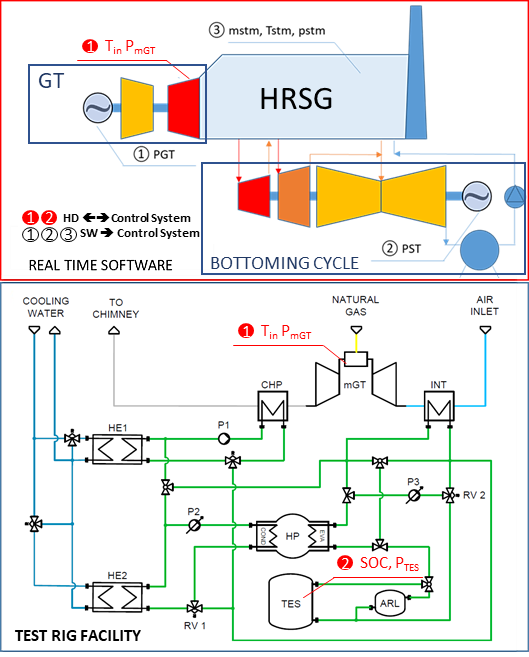
The test rig facility includes two main blocks: real hardware installed in the lab and a real-time simulation engine. The ensemble of hardware and dynamic model creates the cyberphysical system of a PUMPHEAT gas turbine combined cycle (GTCC). Focusing on the installed hardware, it consists of a micro gas turbine (mGT), a HP, one TES, several valves, pumps and heat exchangers (HXs). Regarding the real hardware block, data acquisition and control system is developed in NI Labview environment.
In the following, a schematic representation of the real-time software, which emulates an actual GTCC, is provided together with the connection points with the real facility, shown at the bottom of the figure. The real-time steam bottoming cycle dynamic model as well as the overall cyber control system are developed in Matlab-Simulink. The NI Labview system and the Matlab-Simulink model share information in real-time through a dedicated UDP communication system. Moreover, the plant P&ID integrating all physical components installed in the plant is reported.
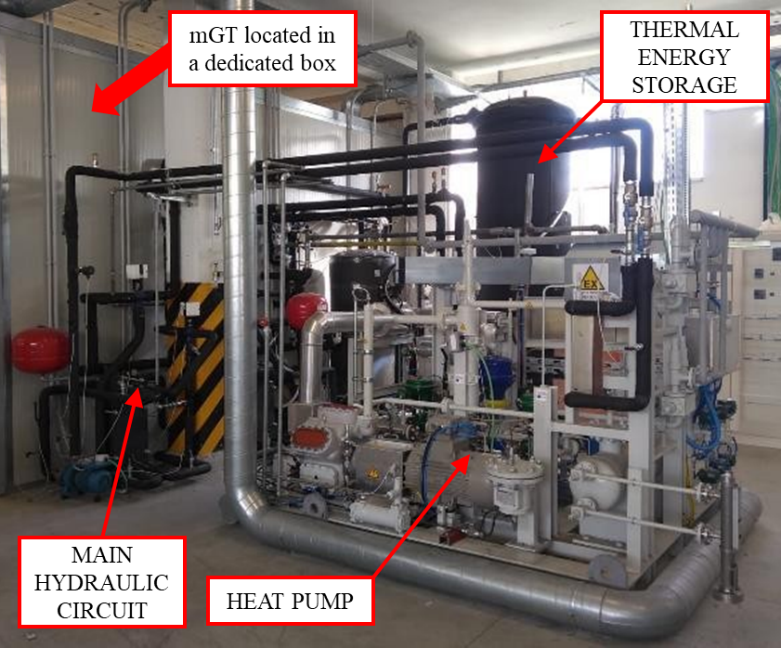
The following picture shows the main physical components of the cyber-physical system, which are:
- Turbec T100 micro gas turbine (mGT),
- Inlet conditioning heat exchanger (INT),
- 10 kWel heat pump (HP) using butane as working fluid,
- Thermal energy storage (TES).
All these components are connected through a dedicated hydraulic circuit that has been designed to reach maximum experimental flexibility: by acting on the numerous three-way valves, several sub-circuits can be activated to perform tests emulating different operating conditions.
Scientific Coordinator: Prof. Alberto Traverso
Hybrid Systems Test-Rig
Hybrid System Emulator
The anodic recirculation system, designed on the basis of a hybrid system power of about 450 kW and a system efficiency of 59%, is composed of a fuel line (for fuel cell fuel flow emulation), an anodic single stage ejector, and the anodic volume. The fuel line has been designed to supply the ejector primary duct with an air mass flow rate (for fuel cell fuel flow emulation) up to 20 g/s. It consists of a 15 kW air compressor, an air dryer, and the flow (MP), pressure (PEjP1), and temperature (TEjP1) sensors. The anodic ejector generates the recirculation flow rate through this system as in a typical SOFC hybrid system. The anodic volume is a nominal diameter pipe (U pipe) of 350 millimetres for a volume of about 0.8 m3. The anodic volume dimension has been designed on the basis of a reference system and a fuel cell dimension consistent with the micro gas turbine mass flow rate. The Rolls-Royce fuel cell stack has been considered. Starting from the RRFCS plant layout some calculations have been carried out taking into account the different system layout and operating parameters. With a simulation tool, already developed, the size and performance of the fuel cell stack coupled with the T100 micro gas turbine have been defined.
Cathodic Side
The test rig designed for hybrid system emulation is composed of a commercial recuperated microturbine package (see Micro Gas Turbine Test Rig) modified for the fuel cell emulator connection, a set of pipes designed for measurement reasons and to widen the operative range of the machine with a bleed, five valves to control the flow rates during start-up phases and a high temperature modular volume for the fuel cell stack physical simulation.
The fuel cell physical emulator, designed with thorough CFD support presented in a previous work, is a thermally insulated modular vessel connected between the recuperator outlet and the combustor inlet, as in a real pressurized hybrid system. This vessel, designed for a maximum temperature of about 630°C (903.15 K), is composed of two collector pipes, connected to the recuperator outlet and the combustor inlet respectively, and five module pipes connected to both collectors. These last pipes are mounted on seams for easy removal, i.e. easy volume dimension change. Both collectors and module pipes have a nominal diameter of 350 millimeters and their total length is around 43 meters for a maximum volume of about 4 m3 (the Greitzer parameter of the compressor is between about 1.0 with the minimum volume and 8.0 in maximum volume configuration, while in the original commercial layout of the machine the Greitzer parameter of the compressor is between about 0.4 and 0.7).

Scientific Coordinator: Prof. Mario Luigi Ferrari
Hybrid Systems – SOFC Ejector Test-Rig
A test rig, partially supported by PIP-SOFC European contract, has been developed to investigate the performance of ejectors for SOFC applications, with the objective to validate the theoretical models and improve the ejector design. At first, the prototype, presented in the previous paragraph, has been tested in classical open loop configuration with the secondary nozzle at atmospheric conditions, feeding the primary duct with compressed air and using a valve to generate different values of differential pressure on the ejector. The plant has been equipped with transducers to measure the mass flow rate, the pressure and the temperature upstream the primary nozzle, the mass flow rate at the diffuser outlet (using a venturimeter) and the differential pressure between the secondary duct inlet and the diffuser outlet. The transducers signals have been connected with a PC, through a PCI device, and acquired using the LabVIEWTM software.
Then, the circuit has been closed introducing a vessel to emulate, in a reduced scale, the anodic volume of the SOFC and an another valve to vary the circuit pressure loss with the requested accuracy level. In this way, through a manual outlet valve, it has been possible to study ejectors at secondary flow pressurized conditions, acquiring also the vessel pressure with another apt transducer. Finally, the plant has been equipped with an electrical heater inside the vessel and thermally insulated to test ejectors with a secondary flow up to 300°C. Even if this temperature is lower in comparison with its operative real value (~ 900 °C), it is enough to reach the similitude conditions that have been considered.

Scientific Coordinator: Prof. Mario Luigi Ferrari