
INTEGRATED SYSTEM 1 -> ENVISION PLANT
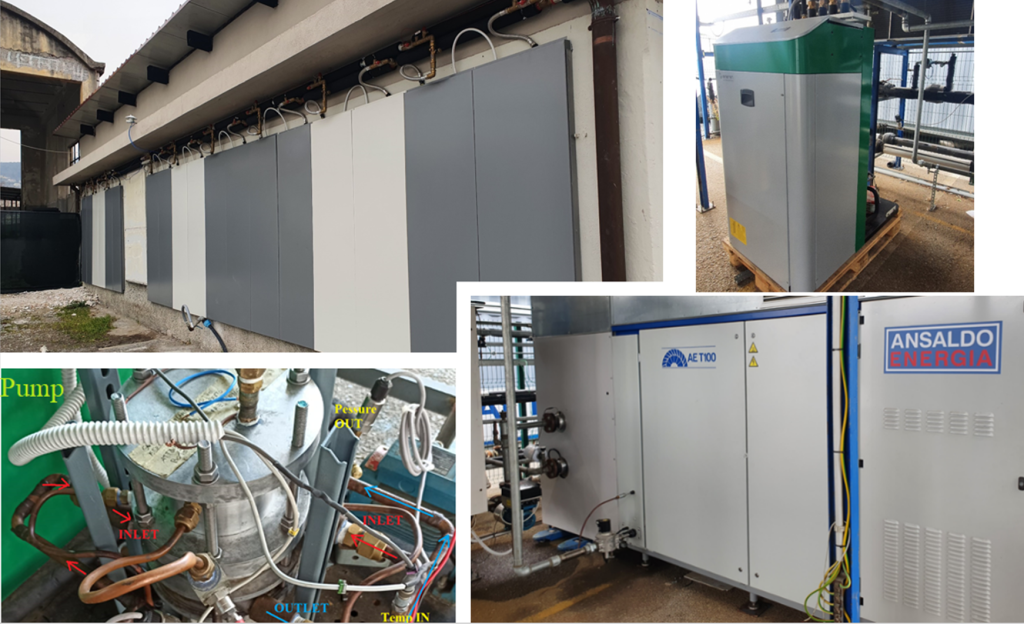
As part of the ENVISION H2020 European project (Energy harVesting by Invisible Solar IntegratiON in building skins), innovative solar collectors have been installed.

These panels differ from commercial ones solely in their specialized surface coatings, which have been designed to enhance the collectors’ absorption capacity in the Near-Infrared Radiation spectrum while balancing aesthetic appeal and efficiency.
Moreover, the implemented system integrates the ENVISION harvesting panels with a 100 kWe CHP-mGT, an innovative high-efficiency prototype heat pump, and two thermal energy storage units. The aim is to test the performance of the harvesting solutions and their integration with other devices within a smart polygeneration microgrid.

The installed integrated system features a double-ring configuration, enabling connection to both the hot and cold sides of the Campus DHN, thus allowing its operation to be tested in a real-world environment. Additionally, the system is connected to the Campus electrical grid. The District Heating Network (DHN) operates as a third-generation system, requiring a supply temperature of approximately 75–80°C, with a return temperature of around 50°C. The expected maximum temperature from the solar panels is about 45°C.
To meet the DHN’s temperature requirements, the integrated system is designed to connect the solar façade panels to the heat pump, which serves as a temperature booster. A low-temperature thermal energy storage unit is placed between the façade panel circuits and the heat pump to mitigate temperature fluctuations caused by variable solar availability.
The system also includes a 100 kWe / 160 kWth micro-gas turbine CHP unit, which supplies both electric and thermal energy. Additionally, a high-temperature thermal energy storage unit has been integrated to provide greater flexibility in managing both thermal and electrical demand. Thermal dissipators are also included to allow independent testing, regardless of DHN requirements, and to simulate different thermal demand profiles.
Related Publications
- Anfosso, C., Gini, L., Bellotti, D. and Magistri, L., 2022. Dynamic model validation of an innovative NIR-solar facade panels-based integrated system. Energy, 2004, p.2965.
- Anfosso, C., Gini, L., Bellotti, D., Pascenti, M. and Magistri, L., 2022. Experimental results of an innovative NIR-solar façade panels-based polygeneration system. Energy, 2004, p.2965.
Scientific Coordinator: Prof. Loredana Magistri
Team Work: Chiara Anfosso, Daria Bellotti, Matteo Pascenti
INTEGRATED SYSTEM 2 -> LOLABAT PLANT
In the framework of H2020 LOLABAT (Long LAsting BATtery) a polygeneration system has been realized.

The main components of the plant are:
- an AE-T100 micro gas turbine (mGT), a combined heat and power (CHP) unit which can provide in nominal conditions 100 kWel and 160 kWth with a nominal electrical efficiency of 30% and overall cogenerative efficiency of 80%;
- a latent heat water thermal energy storage system (TES) of 5 m3 of capacity for the heat storage, resulting in around 150 kWh of maximum thermal capacity (with a thermal swift of around 25 K);
- a heat pump (HP), which requires 10kWel and can provide 46kWth (when the low heat source is at temperature of 35/40°C). The HP exploits the heat from solar façade panels as a low temperature source and is connected to another intermediate TES of the same capacity to balance the panels thermal fluctuations.
- a BESS of 10 kWh – Crate = 1. This BESS is a Ni-Zn based storage which characteristics of safety, low degradation, very high DOD makes this technology suitable for a energy balance application.

The plant is electrically connected to the “Smart Polygeneration Microgrid” (SPM) of UNIGE University Campus (Savona, Italy) which can share electricity to the national grid. The plant components electrically connected to the SPM grid are the mGT and BESS. On the thermal side, the plant is connected to a third generation DHN, where water feeds the system at around 75 °C and returns at around 50 °C.
The LOLABAT project initially anticipates a battery service life of 2.7–5.5 years based on 1000–2000 cycles with 100% DoD. The project aims to improve this to 5.5–11 years by targeting 2000-4000 cycles. With one or two cell refresh as expected in the typical project lifespan of 20–30 years, achieving the higher-end cycle performance would make the NiZn battery suitable for the intended service. It is worth noting that service life projections will increase with reduced depth of discharge cycles.
Related Publications
- Raggio, M., Niccolini Marmont Du Haut Champ, C. A., Reboli, T., Silvestri, P., & Ferrari, M. L. (2023). Energy management and load profile optimisation of 10 kWh BESS integrated into a Smart Polygeneration Grid subnetwork. In E3S Web of Conferences (pp. 1-9). EDP Sciences.
- Raggio, M., Ferrari, M. L., & Silvestri, P. (2025). Optimised scheduling of a cogenerative subnetwork based on a micro gas turbine and thermal storage with the addition of an innovative solar assisted heat pump and Ni-Zn battery. Applied Thermal Engineering, 259, 124889.
Scientific Coordinator: Prof. Alberto Traverso
Team Work: Martina Raggio, Carlo Niccolini Marmont Du Haut Champ, Paolo Silvestri, Federico Reggio, Mario Luigi Ferrari, Matteo Pascenti