Hydrogen Laboratory
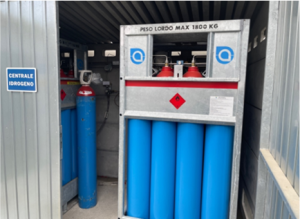
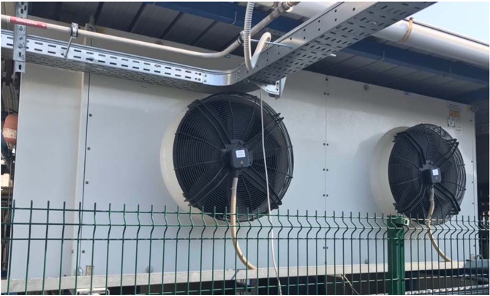
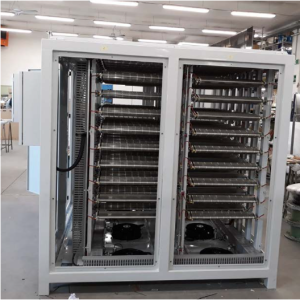
A dedicated hydrogen technologies test laboratory (hydrogen and fuel cell lab H2FC), has been developed for testing in particular fuel cells, electrolyzers, and metal hydrates systems. H2FC lab is fitted out with a double air ventilation system, an APU electric supply, and a hydrogen sensor, to comply with the safety rules for gas hazard areas. Besides, the laboratory is equipped with two direct lines from the gas storage (compressed N2 and H2 tanks at 200 bar) with dedicated pressure reducer able to work with pressure up to 30 bars, a compressed air line (up to 15 bar), and a cooling water system (up to 1.5 l/s and 3 bar), which is then cooled by fan chillers (500 kWt). The lab, finally, includes a connection with the resistive modular load of the IES Lab, which is used to apply different load profiles on fuel cells. The H2FC lab has been recently employed (2020 – 2023) for testing activities on 30 kW and 72 kW PEM Fuel Cell technologies in the framework of the project TecBIA.
HI-SEA Test-Rig
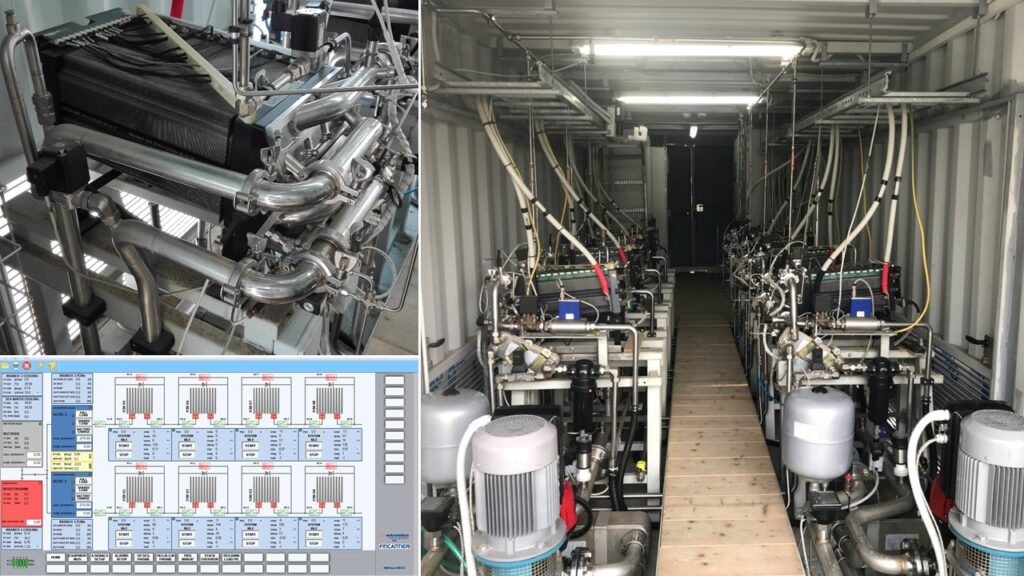
The HI-SEA (Hydrogen Initiative for Sustainable Energy Applications) experimental plant, supported by the University of Genoa through the collaboration between the Thermochemical Power Group (TPG) and Fincantieri, continues the studies started within the TESEO project: High-efficiency Technologies for Energy and Environmental Sustainability On-board (PON02_00153_2939517). The system has been specifically designed for the evaluation of fuel cell technology applications in the maritime sector; it is composed of 8 proton exchange membrane fuel cell stacks (PEMFCs), which boast a high energy density and operate at low temperatures, allowing very fast startup and shutdown times, thus making them the most suitable fuel cells applications in the transport sector.

The eight stacks were supplied by Nuvera Fuel Cell, and are located on two branches, electrically in parallel, and within which they are connected in electrical series. The total installed power is approximately 250 kW. Other auxiliary components make up the system, simulating installation in a boat:
- Fuel cell system installed inside a container (8 ft) that is easy to move and place
- Non oil-free industrial air compressor (12 Nm3 / min) with filters, with dynamics different from those necessary for the correct functioning of the fuel cells; it simulates the connection of the cathodic line to the air line present on board
- Two groups of 16 compressed hydrogen cylinders at 200 bar simulating the fuel storage system
- A resistive modular load to make the system perform at different operating profiles
- Two-stage cooling circuit, to simulate heat exchange with a constant temperature source (sea water)
The plant control system is implemented through an HMI interface that acquires (with a frequency of 1 Hz) the status of the stack contactors, the current and cell voltages (minimum, average and maximum) recorded for each stack, data on the temperature of the cooling circuit and the anodic and cathodic flow rates and pressures. A Labview interface has also been developed, that allows to acquire some of the system parameters with a higher frequency (5 Hz). The system’s control allows to promptly detect malfunctions and act on some of the operating parameters.
From 2019 to 2021, an in-depth experimental campaign was conducted, which led to various results: the compatibility of auxiliaries with the use of fuel cell stacks was studied; a recovery procedure has been developed for stacks when subjected to prolonged periods of inactivity; different stationary and dynamic load profiles are tested to assess the suitability of the system for different operating profiles; some analyses were carried out with Design of Experiment techniques to evaluate the interaction and mutual influence between the operating parameters. It was possible to reproduce the polarization curves of each stack, and to test them in various operating conditions, using static and dynamic load profiles and other load profiles close to those that can be encountered in the naval field. The cells were tested both individually and together (single branch or entire system), to verify their stability even in the presence of the DC / DC converters placed on each branch. The collected data will be analysed with Response Surface Methodology techniques; data will also be compared with those relating to other PEMFC stacks of similar power (30 kW) tested in the H2FC Laboratory as part of the MISE TecBIA research project (low impact technologies for the production of energy on ships), of which the TPG is a partner.
Hydrogen Production
In the framework of the IDRO-RIN TRAN-GENESIS national project, TPG developed a laboratory for the analyses related to hydrogen generation (from renewable energy), storage and utilization.
A pressurised alkaline 40 kW PIEL electrolyser was installed, in order to produce H2 at 4 bar: the hydrogen can be can be employed in 2 stacks of PEM fuel cells (5 KW each one) to generate electrical power or can be stored or converted in other chemical composites. Several experimental tests were performed on the electrolyser to investigate the influence of the operative pressure and of the current density on the performance.
In parallel, other experimental tests were carried out on a methanation reactor which is representing a possible solution to use standard generation technologies with hydro-methane (from hydrogen generated from renewable energy and sequestrated CO2). The reaction is carried out on a catalytic bed of Ru-Al2O3 or Ni-Al2O3 at about 4 bar and in a range of temperature from 300°C to 400°C. In order to evaluate the best thermodynamic/chemical conditions (i.e. choice of catalysts, temperature, H2/CO2 ratio, etc.), several tests were carried out at different values of pressure and temperature.
A typical problem related to hydrogen from renewable energy regards the storage technology. For this reason the laboratory was equipped with metal hydride tanks to analyse storing performance (especially the dynamics related to this technology). Moreover, a new test rig was developed in this laboratory to study chemical storage approach. The aim of this plant is the production of a hydrogen stream from a 2.5% NaBH4-water solution. The plant is based on a catalytic reactor fed by the NaBH4 solution with a pump, a control and measurement system to manage the plant and acquire the experimental data, a set of 3 tanks (containing respectively the NaBH4 solution, an emergency reactor shutdown stream, and the exhaust solution) and a system to dry up the produced hydrogen.
Scientific Coordinator: Prof. Loredana Magistri